Contact Us

Applications
LiDAR for Warehouse Robotics: Obstacle Detection
Discover how LiSSA Industrial’s solid-state 3D LiDAR supports obstacle detection in warehouse robotics, providing the spatial data AGVs and AMRs need to navigate changing environments.
LiDAR for Warehouse Robotics: Obstacle Detection with LiSSA Industrial
A box left in an aisle can change a warehouse robot’s journey. To continue its task, the robot needs to detect the obstruction, understand the available space, and decide how to proceed.
LiDAR provides the spatial information that makes this possible. For automated guided vehicles (AGVs), autonomous mobile robots (AMRs), and automated forklifts, it supports obstacle detection and navigation in environments where goods and equipment are constantly moving.
LiSSA Industrial from Hybrid Lidar Systems brings solid-state 3D sensing to these applications, providing environmental data that a robot’s navigation system can use to plan its movements.
Understanding what lies ahead
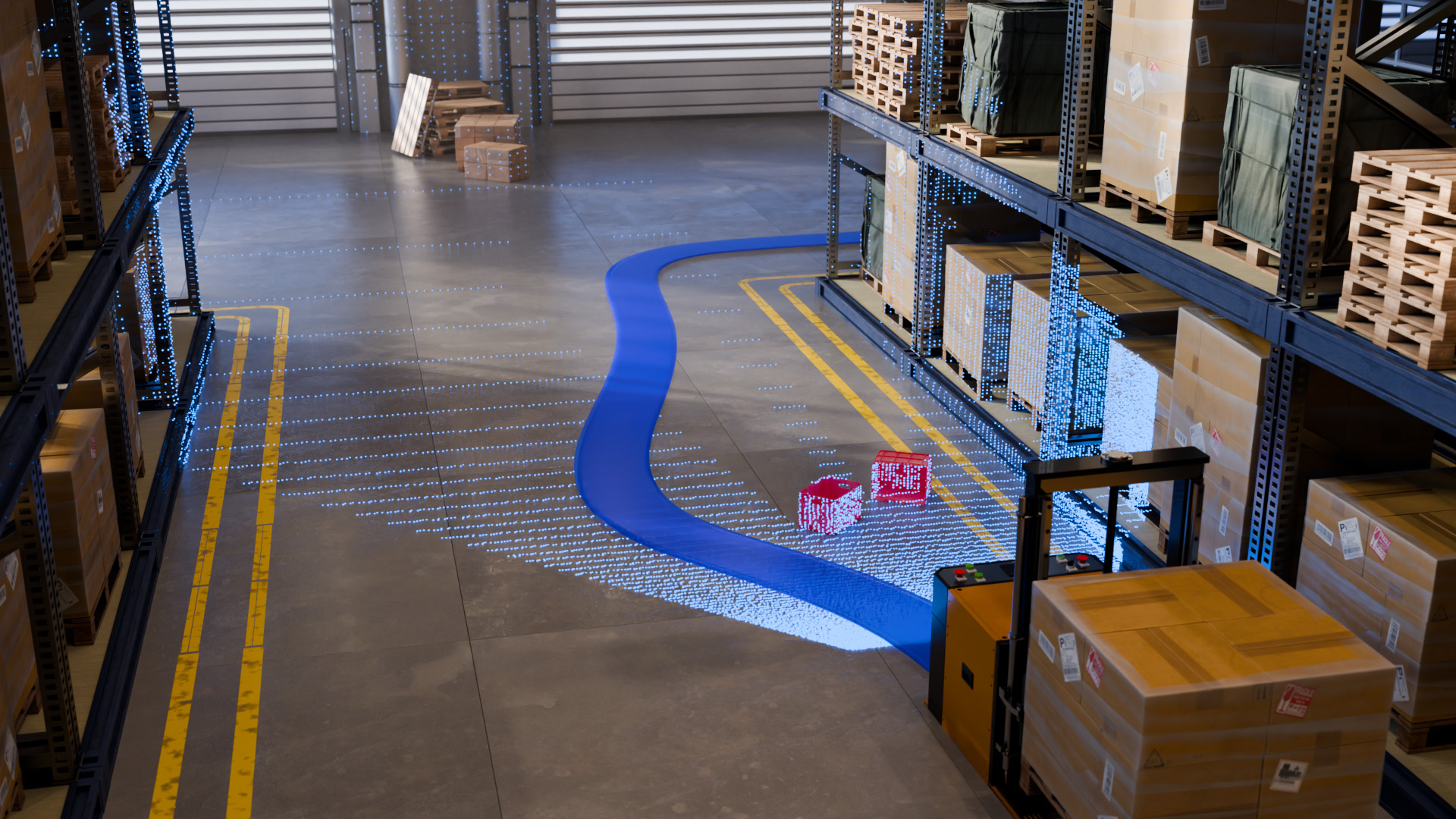
LiDAR uses laser light to measure distances to surrounding surfaces. Thousands of measurements create a three-dimensional representation of the environment, helping perception software distinguish obstacles from available space.
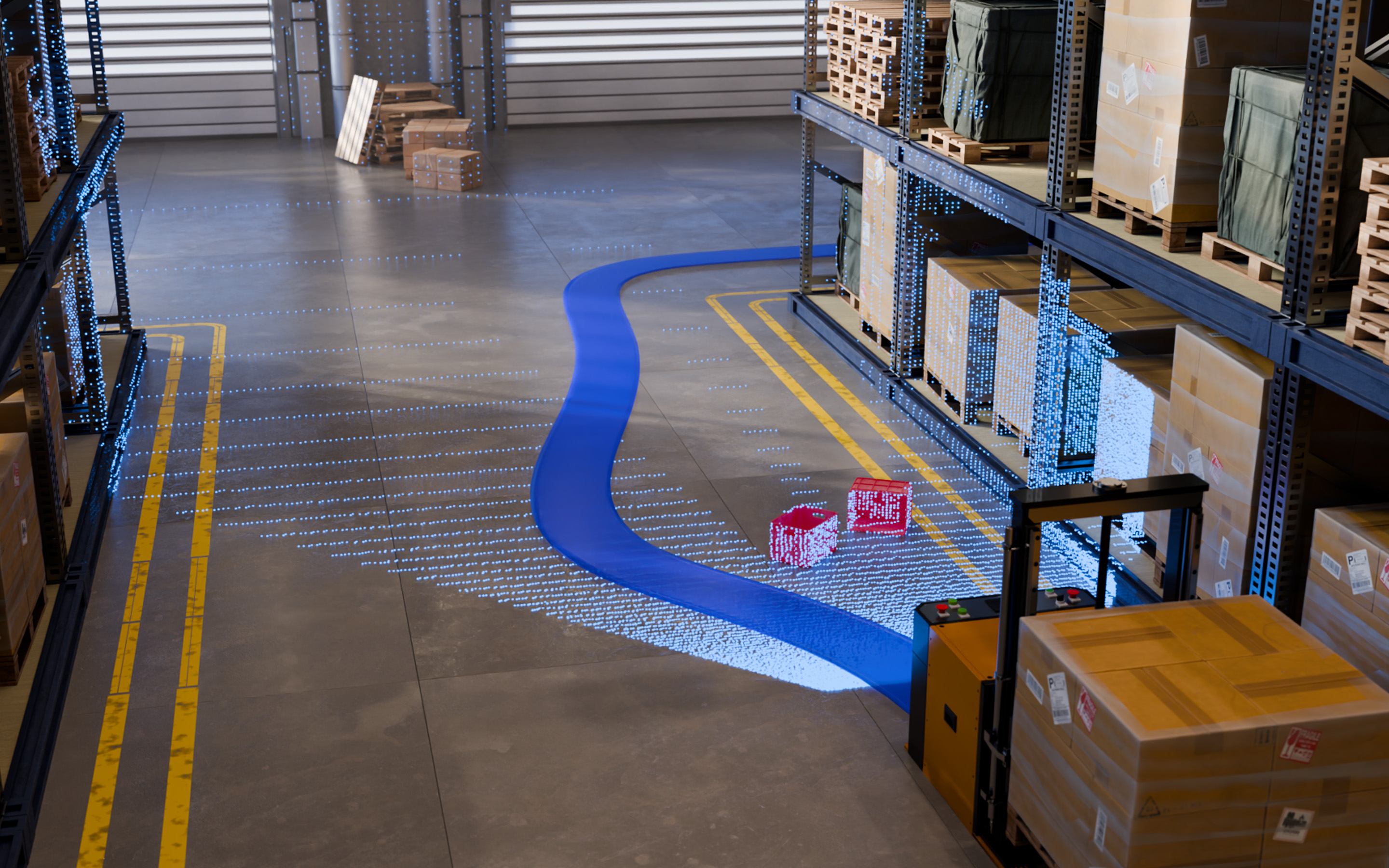
The accompanying render illustrates this process. Blue measurement points reveal the warehouse surroundings, two objects are highlighted in red, and a blue route curves around them. It shows the connection between detecting an obstacle and adapting the vehicle’s path.
Three-dimensional coverage is particularly useful because warehouse obstacles occur at different heights. A box on the floor, a pallet edge, or goods sticking out from a shelf into the aisle may occupy different parts of the robot’s travel space. Within the sensor’s coverage, 3D measurements help the navigation system assess these structures.
From detection to path correction
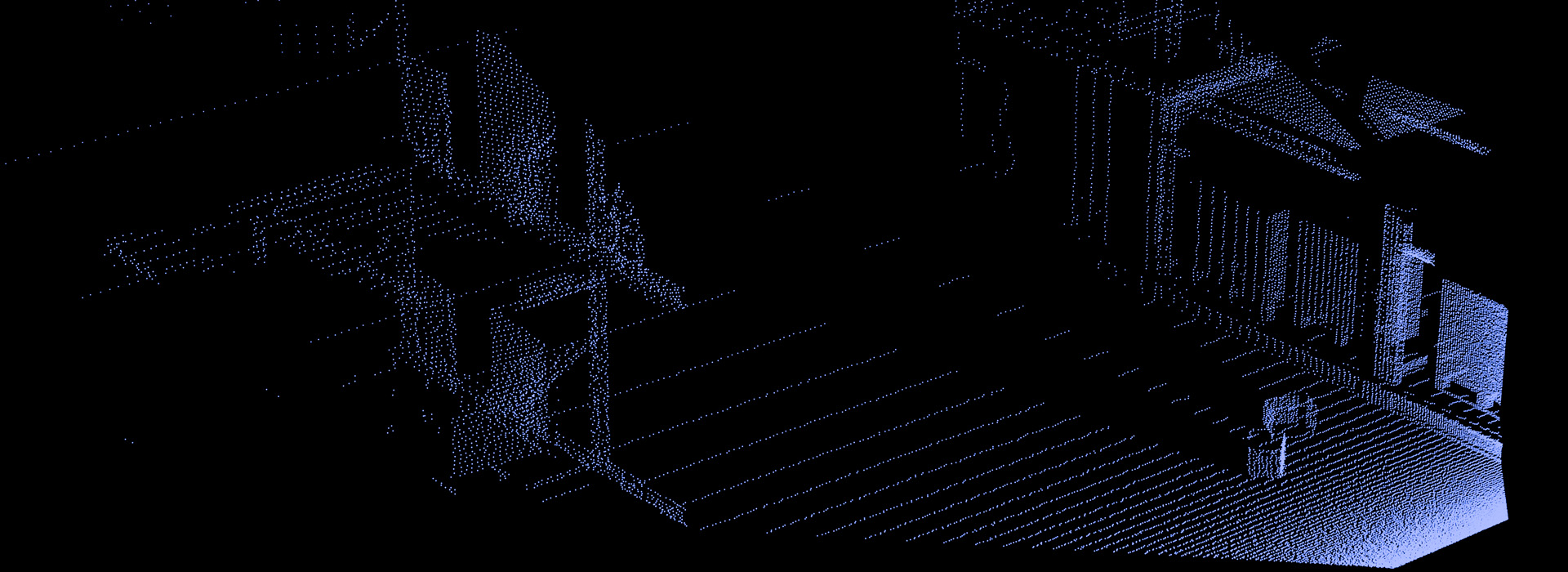
When an object appears ahead, LiDAR supplies updated distance measurements. The robot’s software uses this information to update its representation of the surroundings and evaluate whether its planned path remains clear.
If the vehicle supports dynamic obstacle avoidance, its navigation system can calculate an alternative path, taking the vehicle’s dimensions, load, and required clearance into account. The motion controller then adjusts steering and speed while new measurements continue to inform the system. LiDAR provides the perception data; path planning and vehicle control determine the response.
The response depends on the vehicle and its configuration. A robot capable of rerouting may steer around an obstruction, while a vehicle restricted to a predefined route may stop and wait. Where no suitable route is available, continuing around the obstacle is not an option.
Solid-state 3D perception with LiSSA Industrial
LiSSA Industrial is designed for short- and medium-range industrial sensing. Its solid-state architecture has no moving parts, providing 3D measurements without a rotating scanning mechanism.
The LiSSA Industrial specifications include:
- 240 × 160 pixels: 38,400 pixels for detailed spatial sensing.
- 120° × 80° field of view: broad coverage, with application-specific customization available.
- 0.5–30 m operating range: the manufacturer specifies detection up to 30 m for objects with 10% reflectivity under 100 klx ambient light.
- 3 cm distance accuracy: supporting precise distance measurement.
These capabilities are integrated into a compact housing for industrial applications. Sensor placement and configuration determine which parts of the vehicle’s surroundings are covered.
For warehouse robot developers, LiSSA Industrial provides a source of 3D perception data for obstacle detection and navigation. Integrated with suitable processing and vehicle control, that data can help a robot respond to the kind of obstruction shown in the render.
Explore LiSSA Industrial and discuss your warehouse robotics application with Hybrid Lidar Systems.